
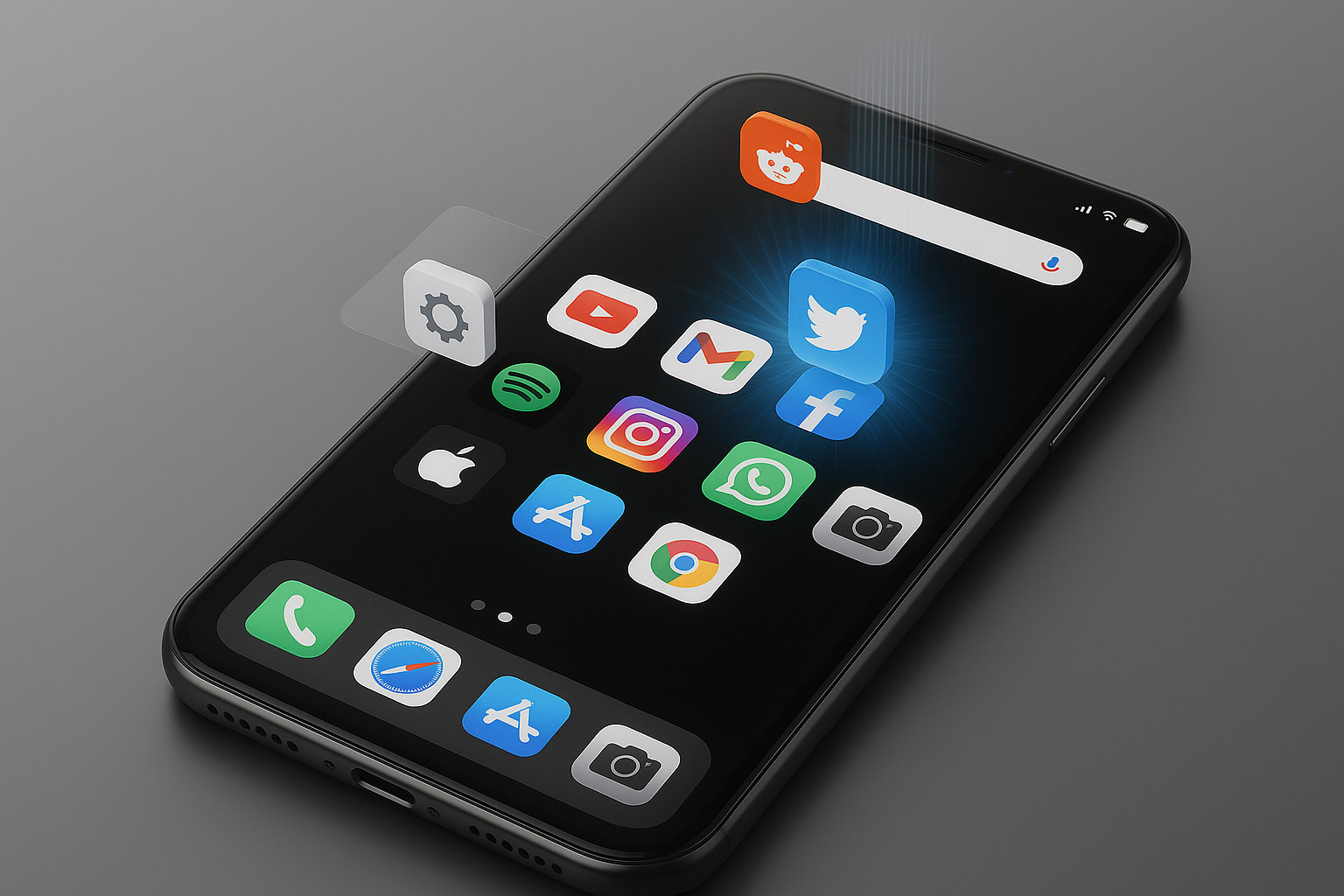
Mobile App Trends 2025: What’s Shaping the Future of Apps
Mobile apps are evolving at lightning speed. From AI-powered personalization to seamless cross-platform experiences, here are the key trends reshaping the mobile landscape in 2025—backed by expert insights.
1. AI & Machine Learning Everywhere.
Intelligent features—like chatbots, recommendation engines, and predictive analytics—are now baseline expectations. In 2025:
--> AI-first design is becoming the norm: 88% of app marketers use AI daily, with 69% integrating it into core operations.
--> Large language models (LLMs) are running directly on devices, enabling voice assistants, translation, and smart suggestions without relying on the cloud.
Bottom line: Smarter, more predictive, and more intuitive apps are here to stay.
2. AR/VR/XR & 5G Integration
Blazing-fast 5G networks (forecasted to reach 1.7 billion subscribers by 2025) are unlocking immersive experiences like AR-enhanced shopping, education, and gaming.
--> Retail giants like IKEA and L’Oréal use AR “try-on” tools.
--> Education and tourism apps overlay immersive content onto real-world landscapes.
Bottom line: Expect seamless mixed‑reality features across sectors.
3. Super-Apps Expansion
The era of standalone apps is ending. Super-apps bundle messaging, banking, e-commerce, travel, and mini‑apps in one hub.
--> Global players in India and Southeast Asia are embracing the super-app model.
--> With rising digital wallets and mobile payments, consolidation across services is logical.
Bottom line: All-in-one ecosystems are becoming the default.
4. Security by Design
Sophisticated cyberattacks have spiked—mobile malware rose 83% year-over-year—so security is not optional.
--> Developers are integrating secure coding, CI/CD security scans, runtime shields, encryption, and zero‑trust architectures.
--> Compliance with privacy regulations is becoming a core competency.
Bottom line: Apps must embed robust security from Day 1.
5. Low-Code/No-Code & Cross-Platform Tools
With more players entering the app space, low-code platforms and cross-platform frameworks offer speed-to-market and cost efficiency.
--> Non-developers can build functional apps rapidly.
--> Businesses gain from a single codebase across Android/iOS.
Bottom line: App development is becoming democratized and streamlined.
6. IoT & Wearables Integration
Smart homes, health trackers, and connected cars expect an app tie-in. In 2025:
--> The IoT segment is booming: projected $621 billion by 2030.
--> Wearables (smartwatches, smart glasses) continue surging—Apple Vision Pro already supports over 600 apps.
Bottom line: Expect richer cross-device ecosystems.
7. Voice & Touchless Interfaces
Demand for efficient and sanitary interactions is rising. Fueled by AI and sensors:
--> Voice UIs are getting smarter—voice payments, command-driven navigation, voice search are expanding .
--> Touchless experiences (gesture, proximity sensing) are finding use in healthcare, automotive, and public spaces.
Bottom line: Hands-free interaction is no longer a novelty—it’s a norm.
8. Predictive Analytics
Personalization is not reactive—it’s anticipatory:
--> Brands use historical data to predict behavior, tailor experiences, and optimize engagement .
--> Predictive models are being built into UX design to boost retention and conversions.
Bottom line: Apps will continue to “know” you before you do.
What This Means for You
Developers -> Prioritize AI/AR/5G, embed advanced security, adopt CI/CD with DevSecOps.
Businesses -> Catch the super‑app trend, embrace low-code for MVPs, ensure mobile-first and sustainable strategies
End Users -> Expect highly personalized, seamless, and secure app experiences across devices
Final Thoughts
2025 isn’t just about incremental upgrades—it’s about rethinking how apps serve users. Intelligence becomes native, interfaces become more natural, and convenience becomes whole-system. The strongest apps will integrate:
- AI + Predictive Logic
- Secure, privacy-conscious design
- Immersive experiences
- Unified ecosystems through super-apps and companion platforms